
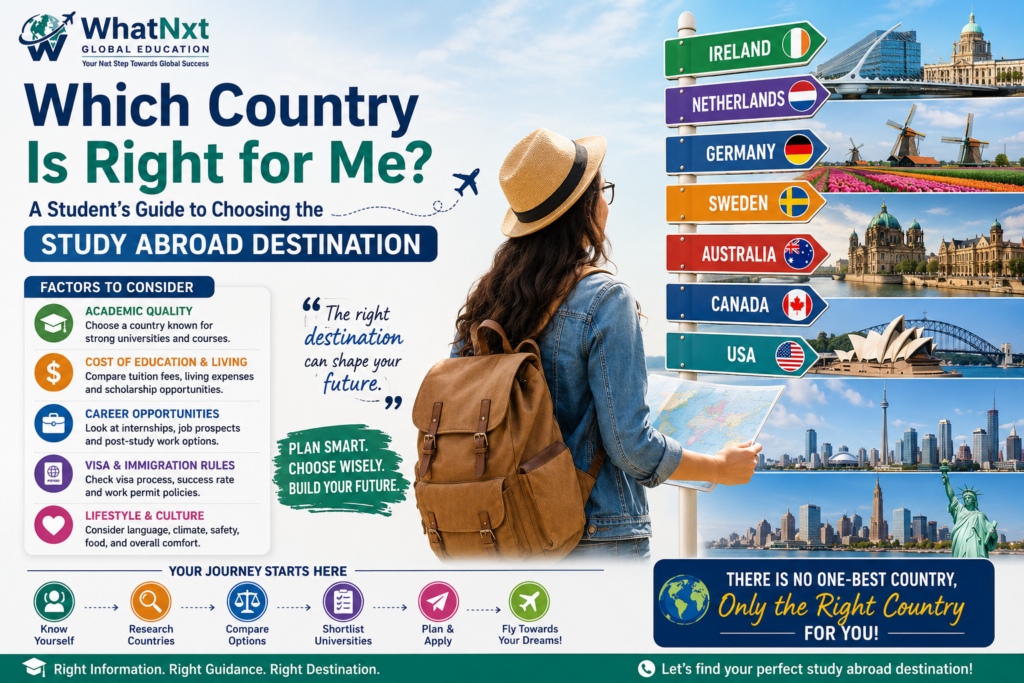
Choosing the right study abroad destination is one of the biggest decisions a student can make. With countries such as the UK, USA, Canada, Australia, Germany, Ireland, Netherlands and Sweden offering different academic and career opportunities, it can be difficult to know where to begin. The best study abroad destination is not necessarily the most popular one. It should match your course, career plans, budget, academic profile and personal preferences.
1. Start With Your Career Goal
Before choosing a study abroad destination, decide what you want to achieve from your education. A student interested in technology may look at countries with strong technology and innovation ecosystems, while someone interested in business may prioritise universities with strong industry connections.
Think about the job you want after graduation and work backwards. Identify the courses that can lead to that career and then compare countries offering those programmes.
2. Choose the Right Course First
Students sometimes choose a country before deciding what they want to study. This can lead to unnecessary compromises.
Shortlist two or three suitable courses and compare their curriculum, duration, practical training, internships, accreditation and career opportunities. Then determine which countries offer strong programmes in your chosen field.
The right study abroad destination should support both your academic interests and long-term career plans.
3. Consider Your Budget
Finances are one of the most important factors when selecting a country. Calculate the complete cost rather than looking only at tuition fees.
Your budget should include:
- Tuition fees
- Accommodation
- Food and transportation
- Health insurance
- Visa-related expenses
- Flight tickets
- Books and study materials
- Emergency funds
Germany, for example, has specific financial and admission requirements for international students, so students should check current official information before making a decision. The Netherlands also provides official information about tuition fees, admission and living arrangements for international students.
4. Check Admission Requirements
Every country and university can have different academic and English-language requirements. Some programmes may require specific subjects, entrance tests, portfolios or professional experience.
Before selecting a study abroad destination, check whether your academic qualifications are accepted and whether you meet the programme’s minimum requirements.
For example, Study in NL explains that admission requirements can vary by institution and programme. Similarly, Germany’s DAAD provides an admissions database to help international students understand qualification requirements.
5. Think About Language
English-taught programmes have made many European countries attractive to international students. However, studying in English does not mean that the local language is irrelevant.
Consider whether you are comfortable learning the local language for everyday communication and potential employment. A basic understanding of the local language can improve your experience and help you interact with the community.
6. Compare Career Opportunities
Education should be viewed as an investment in your future. Research the industries, employment opportunities and skills in demand in each country.
Do not choose a country simply because it has a prestigious university. Consider whether the course provides practical learning, internships, industry projects and opportunities to develop relevant skills.
Your study abroad destination should ideally support your career goals beyond graduation.
7. Consider Lifestyle and Culture
Academic factors are important, but your personal comfort matters too. Think about climate, food, culture, transportation, accommodation, safety, social life and distance from India.
Some students prefer busy cities, while others enjoy smaller university towns. Some may prefer warmer climates, while others are comfortable with cold weather.
Sweden, for example, provides official resources that help prospective international students explore whether the country suits their interests and expectations.
8. Research Visa and Immigration Rules
Visa requirements can change, so students should always use official government or university sources for current information.
Check financial requirements, documentation, application procedures, residence permissions and rules concerning student employment. Avoid relying on social-media posts or outdated articles for important immigration decisions.
9. Compare Ireland, Netherlands, Germany and Nordic Countries
Indian students looking beyond traditional destinations can consider European options such as Ireland, Netherlands, Germany and Nordic countries.
Ireland can be attractive for students looking for English-language education and an international business environment. The Netherlands offers a wide range of English-taught programmes. Germany is particularly important to research for students considering engineering, technology and other fields, while Nordic countries can appeal to students interested in areas such as sustainability, innovation and technology.
Each study abroad destination has different strengths, costs and admission requirements, so comparison is essential.
10. Create Your Personal Country Shortlist
After collecting information, shortlist three to five countries. Give each one a score for:
- Academic fit
- Course quality
- Total cost
- Career opportunities
- Admission chances
- Visa requirements
- Lifestyle
- Personal preference
The highest-scoring country is not automatically the best choice. Your final decision should reflect your individual circumstances.
Conclusion
There is no single best study abroad destination for every student. The right choice depends on your academic background, course, career goals, finances and personal preferences.
Instead of following trends or choosing a country because friends are going there, research carefully and compare your options. A well-planned decision can help you avoid unnecessary expenses and choose a programme that supports your long-term goals.
If you are confused about which country to choose, professional education counselling can help you compare destinations based on your profile, budget and career plans. WhatNxt Global Education can help students explore both traditional and alternative European destinations and make a more informed study-abroad decision.